


World Central Kitchen provides meals in response to humanitarian, climate, and community crises worldwide, activating networks of local restaurants, food trucks, and emergency kitchens to serve survivors quickly. Media Cause is a marketing agency specializing in nonprofit growth, blending sector expertise with marketing innovation.
The bet WCK needed to make
World Central Kitchen had a reliable donor base. Affluent women 65 and older had responded consistently to their creative for years. They had a paid media engine that engaged and activated this audience consistently in response to disasters around the world.
But heading into year-end 2025, the team at Media Cause was looking at a different question: could they help WCK reach younger Americans and move them to give to international humanitarian crises they had little prior connection to? And if so, which message would actually do it?
Past campaign data couldn't answer that. Like most nonprofits, younger donors had never been a meaningful part of WCK's base, so there was no signal to follow. And as it turned out, the message that ended up mattering most didn't look like a winner until you knew where to look.
What the test uncovered
The question wasn't whether WCK's creative worked — it was whether it worked with people who had never given to them before, specifically younger Americans with no prior connection to international humanitarian causes.
Past campaign data couldn't answer that, and traditional A/B testing wasn't going to help either — this is built for optimizing behavior among people already in your funnel; telling you what is driving clicks, conversions, and cost per acquisition. It doesn't measure whether a message will move someone who's never heard of your organization, and it can't tell you that before you spend.
In October 2025, Grow Progress ran a Rapid Message Test using randomized controlled trials, the methodology used in clinical research. A nationally representative group of Americans was randomly assigned to see different WCK creative or a placebo, then asked the same outcome questions. The gap between groups revealed how much each message actually shifted the audience attitudes WCK cared about: trust, donation intent, and whether any message caused backlash.
The team tested six pieces of creative across three crisis contexts: a domestic flood response in Texas, WCK's operation in Ukraine, and a human story from a displaced person in Gaza.
Across the full audience, all of WCK's messages drove donation intent, but the Trust results told a more complicated story. Texas and Ukraine were the strong performers. Both Gaza messages landed in "no measurable effect" territory on Trust, sitting at +1 and +3. These results taken at face value might have pointed the team away from Gaza entirely. What saved it was the insights revealed when breaking the data out by age.
Among 18–34 year olds, the Ukraine human-story message that had performed strongly overall dropped to +1, statistically invisible. The Gaza human-story message jumped to +11, landing firmly in persuasive territory. Creative that looked like a weak performer in the aggregate was among the strongest messages the team had for its target growth audience.
Past campaign data could not have surfaced these nuances. It required testing with people outside the existing base.
"We ran this messaging testing in October and by the time we started planning our December campaigns, we had everything we needed."
— Melvin Karsenti, VP & Group Account Director, Media Cause
From insight to campaign results
The Media Cause team built from what the test found, but it required trusting a subgroup result that the aggregate data would have buried. At the overall audience level, the Gaza messages had no measurable effect on Trust. A team relying on topline results alone would have deprioritized Gaza and committed budget behind Texas and Ukraine. The 18–34 breakdown told a different story, and the team followed it.
They created an ad that conveyed the scope of WCK's work in Gaza while making the donation feel immediate and tangible, framing it as the equivalent of skipping a single takeout order. It outperformed traditional match messaging with the younger segment by a wide margin.
The team also layered in real-time context. Gaza remained prominent in the news cycle. A matching gift opportunity was available to amplify the ask. The research gave them a clear direction; the timing gave them a reason to move fast.
For younger audience segments, Media Cause and WCK were often happy just to break even on ad spend with a $1 ROAS as the benchmark. Total donations from the Gaza campaign reached $250K+ at the end of the year.
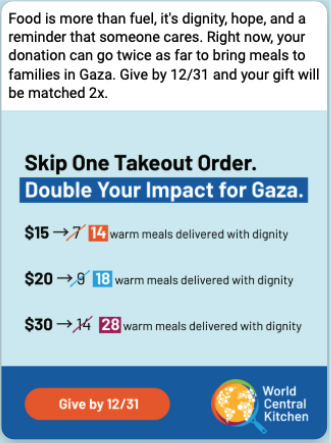
The Gaza ad that outperformed traditional match messaging with 18–34 year olds
Why this mattered
Three things made the difference here that traditional campaign optimization couldn't have delivered.
- Insight before spend. The team knew which messages would move an unfamiliar audience before committing budget, eliminating the most expensive kind of risk in nonprofit fundraising: creative that falls flat with a segment you have no data on.
- Persuasion, not just conversion. The randomized controlled design captured actual shifts in trust and donation intent among a representative population, not just clicks from people already in the funnel.
- Audience-specific direction. The aggregate results would have pointed the team away from Gaza entirely. Both Gaza messages showed no measurable effect on Trust across the full audience. Without the subgroup view, that's where the analysis stops, and the strongest message for the audience they most needed to reach never gets made.
Ready to find the messaging that resonates with your audiences? Learn more about Grow Progress's Rapid Message Testing.