
Save the Children runs one of the largest paid media programs in international humanitarian fundraising. Their ads are professionally produced, emotionally resonant, and backed by decades of direct response expertise. By every conventional measure, they work, and "working" has typically meant one thing: did donations go up?
Grow Progress set out to answer a different set of questions. What does the ad actually do to the people who see it? Does it work the same way for a 28-year-old as it does for a 62-year-old? And is the spend behind one of their most significant creative investments actually going to the right place?
The persuasion results were expected. The emotional data was not.
The Setup
Heading into mid-2026, Save the Children had two video ads in active rotation. The first, called Day One, launched in late 2025 and quickly became the organization's highest-spend creative, opens with 19 days of children escaping conflict, culminating at a Save the Children relief tent, then resets: today is another Day One for a child in crisis. It is an urgency loop by design, no narrator, no voiceover, just the unfolding story. It had an estimated $9 million in broadcast and CTV spend behind it, reaching 243 million impressions (via AdImpact).
The second ad, Hunger, gives children their own voice. A child in East Africa speaks directly to camera in Swahili, explaining that hunger had been getting better in her community, until the drought made it worse than ever. A girl speaking Ukrainian describes how war in Ukraine forces families to flee and lose access to food. A voiceover closes with a concrete ask: $10 a month, $0.30 a day, closer in style to a traditional direct response appeal than Day One's narrative approach.
The two ads are not just testing different messages. They are testing different production philosophies: one bet on immersive storytelling to move people, the other on authentic child voice and a clear transactional ask. Both were live, both were reaching audiences.
In July 2026, Grow Progress ran a Rapid Message Test with 2,039 Americans, each randomly assigned to see Day One, Hunger, or a placebo. The gap between groups revealed how much each ad shifted donation intent, personal responsibility, urgency, brand favorability, and emotional response.
What the Data Said
Day One was the stronger ad, and it was not particularly close.
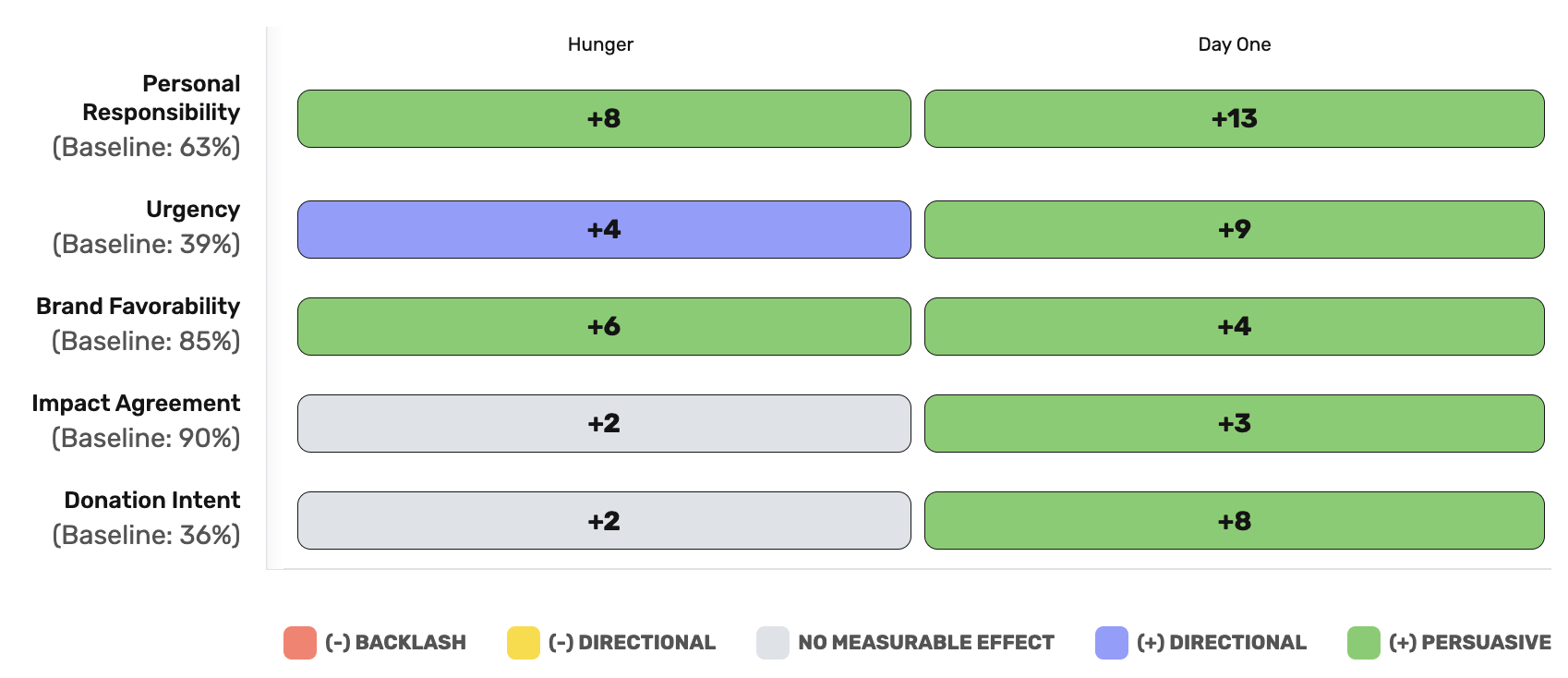
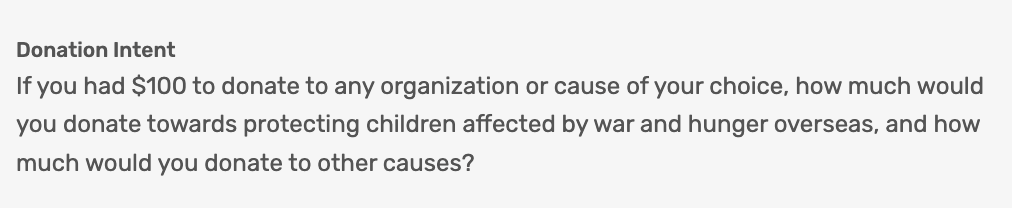
Across every success question that matters, Day One outperformed Hunger. It drove +8pp on donation intent vs. Hunger's +2pp. It moved personal responsibility by +13pp, nearly double Hunger's +8pp, and it drove stronger urgency. The one exception was brand favorability, where Hunger outperformed Day One, +6pp vs +4pp. But brand favorability started at a near-ceiling baseline of 85% and 90%. When almost everyone already has a favorable opinion of Save the Children and already believes they provide critical care, moving those numbers further is far less meaningful than moving donation intent, which started at a baseline of just 36%. On the metric that actually drives revenue, Day One won convincingly.
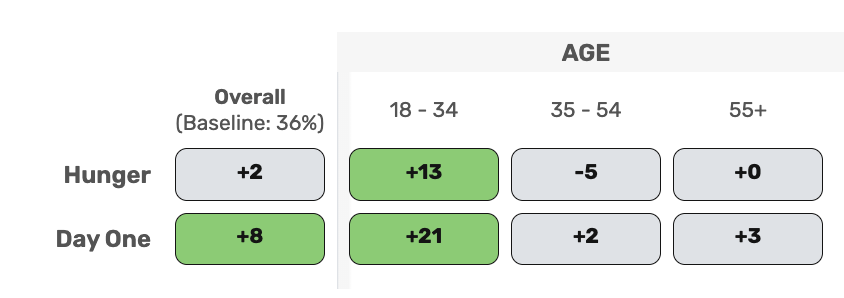
But those topline numbers obscure something important about who Day One actually moved. Among 35–54 year olds, Day One produced no measurable effect on donation intent. Among 55+, the same.
The +8pp overall was driven almost entirely by non-donors and 18–34 year olds, the acquisition audience. Day One is not an everyone ad, it is an acquisition ad, and a strong one: it converts strangers, not the base.
Hunger tells the same story from a different angle. Among 35–54 year olds it produced no measurable effect on donation intent either. Both ads have audiences where they work harder than others. That story only surfaces when you break the data down.
That matters because acquisition is the expensive, hard part of fundraising. For organizations facing aging donor bases and shrinking alternative funding streams, an ad that reliably moves the new-supporter audience is arguably the most valuable creative asset they have. The emotional response data adds precision to that picture: neither ad produces a measurable effect among 35–54s and 55+. These are not flaws, they are signals about where each ad belongs in a segmented media strategy.
Traditional campaign optimization would have confirmed Day One as the winner and stopped there. But topline results do not measure emotional experience, and that is where the story gets complicated.
The Finding That Reframes Everything
Here is the finding that no campaign dashboard would ever surface: Day One made people meaningfully sadder than Hunger, and it also outperformed Hunger on every success metric that matters. The one exception was brand favorability, where Hunger edged ahead, but as noted earlier, that metric started at a near-ceiling baseline of 85%, making it the least meaningful measure of the two.
This is where the research becomes relevant. A study published in the Journal of Business Research found that "appeals combining hope and sadness produce significantly higher donations" than sadness-dominant approaches, and that emotion arcs moving from sad to hopeful generate more giving than those moving in the opposite direction. Day One moves more people to sadness. Hunger moves more people to hope. That ratio, not the raw sadness number, is what the long-term donor relationship is built on.
Both ads moved people emotionally, 69% of Day One viewers and 67% of Hunger viewers felt sad or hopeful after watching. But the mix matters. Day One skewed heavily toward sadness: 60% felt sad, while only 9% felt hopeful or motivated. Hunger produced a more balanced emotional response: 52% felt sad, with 16% feeling hopeful and 12% motivated. Neither ad leaves viewers primarily feeling hopeful. But Hunger comes meaningfully closer.
There is also a competitive dimension. In a 2025 Audience Understanding Survey of 600 Americans aged 18–54, Grow Progress found that 55% of donors who gave exclusively through crowdfunding platforms like GoFundMe, and gave nothing to traditional nonprofits, are under 35. These donors are not anti-giving. They are choosing platforms that offer a more immediate, personal, and hopeful giving experience over traditional nonprofit appeals. Crowdfunding platforms are built around personal stories, immediacy, and a clear sense of impact, the emotional experience that hope-dominant giving produces. An ad that moves younger Americans primarily toward sadness, with little hope to anchor the feeling, is competing against platforms that are purpose-built to offer the opposite.
Both things are true at the same time. The $9M ad is simultaneously Save the Children's most persuasive creative and the one producing the most sadness-heavy emotional experience. That is not a creative failure, it may be exactly how the urgency loop is designed to work. The discomfort is the mechanism. But it is a trade-off being made without full visibility into what it costs, and that changes how you should think about it.
The 18–34 Story
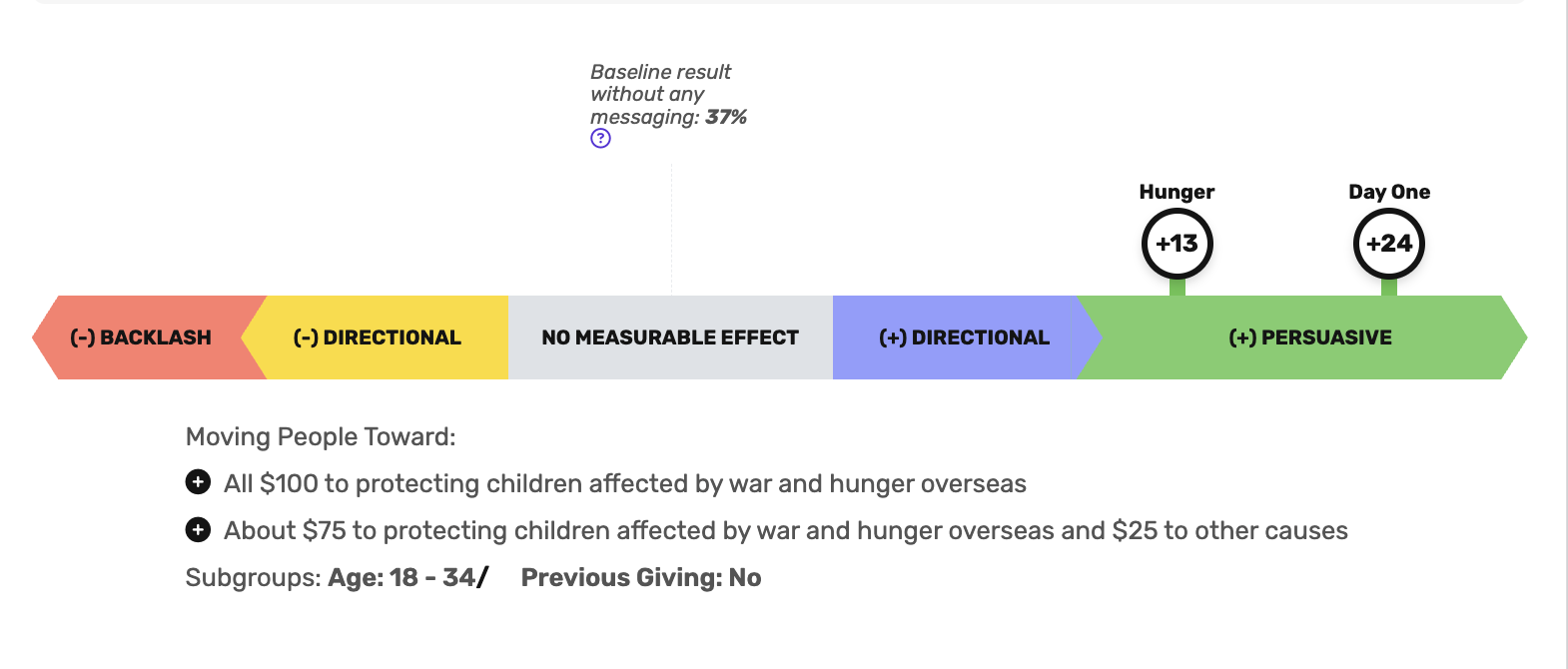
Among 18–34 year olds who have never given before, Day One produced +24pp on donation intent, the single largest effect size in the entire study. Among 18–34 year olds overall, Day One produced +20pp. Both are persuasive. Day One is nearly twice as persuasive as Hunger among first-time youth donors.
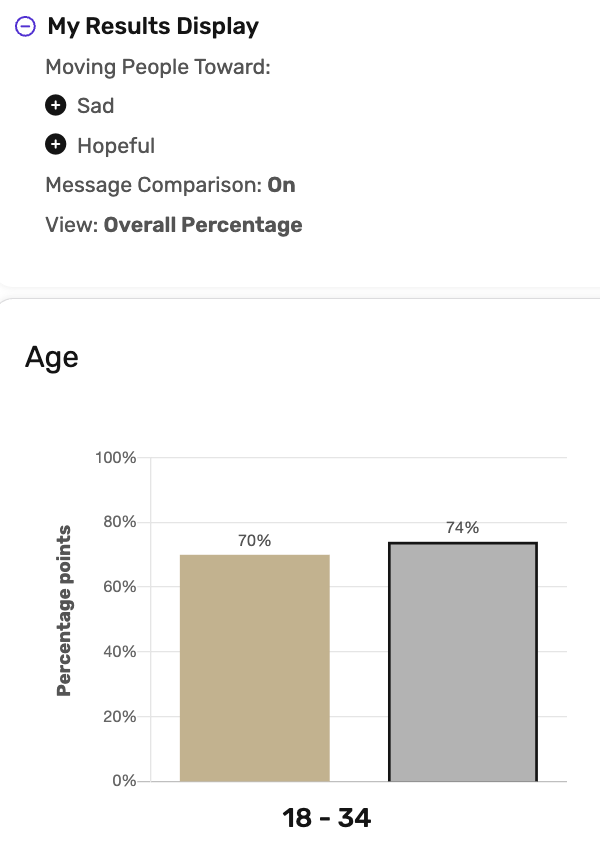
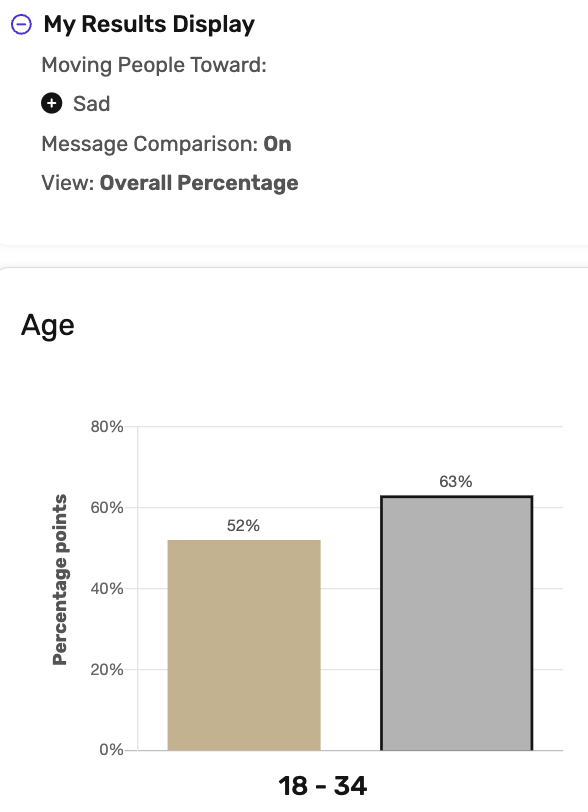
But among 18–34 year olds, Day One produced the most skewed sad-to-hopeful ratio of any age group tested. Both ads moved young viewers emotionally at nearly the same rate, 74% of Day One viewers and 70% of Hunger viewers felt sad or hopeful. But 63% of Day One's young viewers felt sad specifically, vs. 52% for Hunger. Both ads move younger audiences primarily toward sadness, but Day One does so more heavily, while Hunger leaves more room for hope.
According to the 2026 Neon One donor report, the average recurring donor gives $938 a year, renews their giving at a rate of 79%, and continues giving for nearly eight years. A one-time donor, by contrast, typically gives once and does not give again, with most lapsing within one to two years. An acquisition strategy that brings donors in primarily through sadness, with almost no hope or motivation to anchor the relationship, is not the foundation that produces the first kind of donor. That tension is sharpest with the audience Save the Children most needs to grow.
What This Means
Day One is the right ad on the metrics that matter today. The data does not say stop running it.
What the data says is: know what you are trading. Day One makes people sadder and performs better. Those two things are connected, not incidental. The urgency loop that makes stopping feel impossible is also the mechanism that pushes the emotional experience heavily toward sadness, leaving younger viewers in particular with far less hope than the research suggests is needed to anchor a long-term donor relationship.
The research suggests the most valuable question is not whether to run Day One but whether it can be reworked to give the emotional experience somewhere to go, a moment of resolution, agency, or hope, without losing the urgency that makes it perform. Hunger's child-voice approach and concrete $10 ask already move in that direction, producing a meaningfully better sad-to-hopeful ratio particularly among younger audiences. Whether it goes far enough is a testable question.
These are not conclusions. They are the beginning of a smarter creative strategy, one that could not have started without knowing what the ads were actually doing to the people watching them.